
Carbon County Release Date Types
Several dates can appear in one case. The sentence minimum is often the first point at which parole may be considered. It is not a promise of release. The maximum is the legal sentence endpoint after lawful credit and recalculation, unless another sentence or hold controls. A Board decision date records an action, not the gate event. An actual release date records the completed exit from a custodian. These labels must stay separate.
- Minimum date
- The first ordinary parole eligibility point set or calculated under the sentence.
- Maximum date
- The endpoint of that sentence, subject to lawful credit and recalculation.
- Projected date
- An estimate or planned date that can change before release.
- Actual release date
- The date the custodial agency reports that its custody episode ended.
- Discharge
- The end of a sentence or supervision term, not merely release from a facility on parole.
Pretrial custody usually has no sentence-based projected release date. Bail, a hearing, dismissal, or a later plea can change custody. A transfer date is also not a community release date. Read the legal authority and destination rather than treating every exit from Carbon County Correctional Facility as freedom from all custody.
Find Carbon County Release Dates
Begin with the criminal docket. The Pennsylvania UJS Case Search can show bail, disposition, sentence, and later parole orders. Determine whether the person remains a Carbon County sentence under county court authority or was committed to PA DOC. That single distinction controls which calculation and office apply.
- Match the person to the correct criminal docket and read every active case that could affect custody.
- Identify pretrial, county-sentenced, or state-sentenced status from the order rather than the arrest location.
- For a county sentence, obtain the minimum, maximum, good-time eligibility, and parole order from Carbon court and county records.
- For a state sentence, use the PA DOC locator, sentencing order, Board Action, and DOC sentence records.
- Confirm the actual exit with the releasing agency and check the destination for another hold or transfer.
Carbon County Adult Probation/Parole and Carbon County Correctional Facility share the county date work described in Administrative Order 9-2020. The probation database includes the docket number, charge, minimum release date, and maximum sentence. CCCF can access it. The database is not advertised as a public name-search portal, so request the docket, order, or existing release record instead.
Carbon County Sentence Calculation
The Carbon County court fixes the sentence and minimum parole boundary. Adult Probation/Parole and prison administration calculate the minimum date, any applicable local good time, and maximum expiration. The facility reports earned or revoked credit so the minimum can be adjusted. The court order plus the agency calculation is the authoritative county path. PA DOC's public locator has no field for a county projected date.
Under Carbon County Administrative Order 9-2020, an eligible person may earn four days of credit for each month served through good behavior. As many as two more days per month may come from in-house work release, alternative work, or qualifying facility programs. The total cap is six days per month. The sentencing court must state eligibility, and the credit reduces the minimum rather than the maximum.
| County factor | Effect on the date |
|---|---|
| Eligible good behavior | Four credit days per month served |
| Qualifying work or program | Up to two added credit days per month |
| Monthly total | Capped at six credit days |
| Disciplinary revocation | Credit can be lost and the minimum recalculated |
| Maximum sentence | Not reduced by this local good-time formula |
Mandatory portions, flat sentences such as summary matters, weekend sentences, and people ruled ineligible do not receive this credit. A minor infraction may create a parole setback. Major misconduct can also prevent automatic parole in a category that would otherwise qualify. The written sentence and local order control, not a hand calculation made from a booking date.
Carbon County Good-Time Quirks
Weekend and partial-confinement sentences have a special Carbon County rule. Arrival up to one hour late shifts the release time by the amount of lateness. Arrival more than one hour late can require a parole petition. Breaking weekend-sentence rules can convert the sentence to continuous days. These facts make a simple calendar estimate unreliable even in a short county case.
Automatic county parole at the minimum may apply to sentences of 90 days or less, weekend sentences, time-served cases, or cases in which the court says no pre-parole investigation is needed. The person must comply with the order and avoid major misconduct, and a contrary court direction controls. Adult Probation/Parole still verifies the proposed plan and completes intake.
A grant can be rescinded or modified before it is executed. A proposed home or treatment plan may fail verification. Detainers can keep the person in custody after the Carbon sentence permits release. Each of these events changes the expected gate outcome without changing the basic math first used to find the minimum.
Note: Carbon County good time affects an eligible minimum date, so it must not be described as a shorter maximum sentence.
Carbon State Release Date Records
State-sentenced cases use Pennsylvania's indeterminate framework. Under 42 Pa.C.S. §9756, the court sets a maximum and generally a minimum no greater than half the maximum. Under 61 Pa.C.S. §6137, parole is discretionary and ordinarily cannot begin before the minimum. Pennsylvania expressly rejects a universal claim that a person must serve 85 percent of the maximum.
The PA DOC Inmate/Department Supervised Individual Locator helps identify current state jurisdiction or supervision. Search by inmate or parole number when possible, or use name and the available filters. The current inmate detail includes identifiers, location, committing county, update time, and sometimes an image. It does not display Projected Release Date, Tentative Release Date, Minimum Date, Maximum Date, or Controlling Maximum Date.
The Department Supervised Individual detail can show an actual Release Date for a person who remains under state supervision. That field is evidence of the reported prison release, not the projected date that existed beforehand. The official search interface makes the available inputs clear. Review the PA DOC locator source before comparing the captured view.
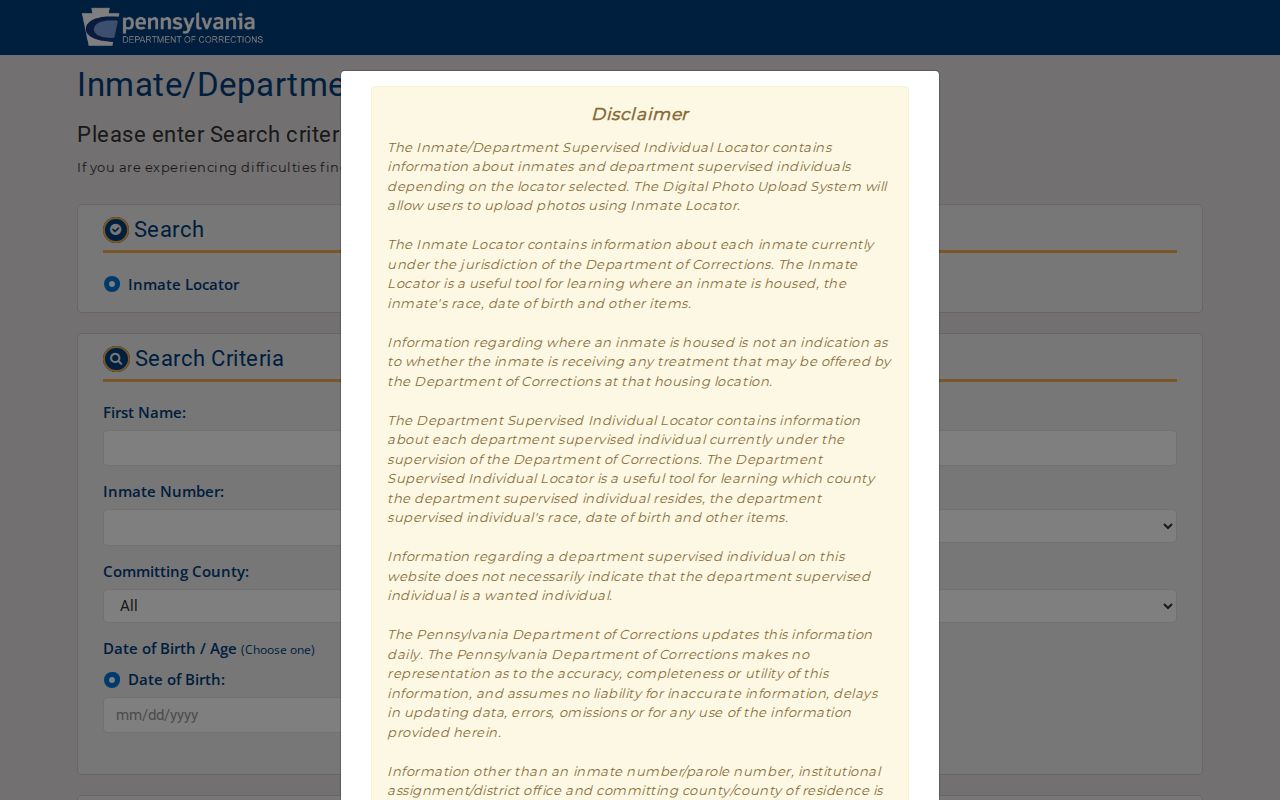
The screenshot shows the current locator search rather than a nonexistent projected-date field, so sentence and Board records remain necessary for date calculation.
Pennsylvania Release Eligibility Programs
RRRI, the Recidivism Risk Reduction Incentive, is a limited statutory program under 61 Pa.C.S. Chapter 45. For a person found eligible and certified, its minimum is three-fourths of a regular minimum of three years or less, or five-sixths when the minimum exceeds three years. The statute controls rounding. Court eligibility, DOC certification, required conduct and programs, a reentry plan, and the Board's public-safety decision still apply.
RRRI advances a parole eligibility point. It does not cut the maximum in the way Carbon County's local credit is sometimes misunderstood, and it does not prove release. Short Sentence Parole under 61 Pa.C.S. §6137.1 is another distinct process with eligibility limits and statutory exceptions. Neither program should be labeled universal earned time.
For state cases, the sentencing order, Board Action, and DOC computation answer different parts of the question. The order states the judicial sentence. DOC performs sentence administration. The Board grants or refuses parole when it has authority. A projected date drawn from only one source can miss a detainer, plan issue, or later Board action.
Why Carbon Release Dates Change
A date can move for lawful reasons after the first calculation. County credit can be earned or revoked. A court can modify an order. State credits can be recalculated. A parole plan may not be approved. A grant can be rescinded before release. New charges, warrants, and detainers can also keep someone in custody or transfer that person to another authority.
| Change | Record to check | Possible result |
|---|---|---|
| Good-time credit earned or lost | CCCF and Adult Probation/Parole calculation | County minimum moves |
| Parole grant or refusal | County order or state Board Action | Release authorized, delayed, or refused |
| Plan approval problem | Supervision and parole records | Gate date delayed |
| Detainer or other sentence | Docket and release destination | Transfer or continued custody |
| Disciplinary action | Facility and sentence calculation | Credit loss or setback |
| Processing after order | Actual facility release entry | Exit occurs later than legal action |
Record the date each source was checked. PA DOC data updates daily, while court and facility actions can post on different schedules. A minimum date from an old order should not be reported as current without checking later entries. The Carbon County VINE inmate check can supply an event notice, but the originating record still confirms why the date changed.
Confirm Carbon County Actual Release
For a county case, ask for the existing CCCF booking and release entry, including actual release date and time, authority or type, and destination. Pair it with the court docket and parole order. If written proof is needed, use the Carbon County Right-to-Know route rather than asking the county to create a projected-date explanation. Sheriff Daniel Zeigler's office does not calculate CCCF sentence dates.
For a state case, retain the sentencing order, PA DOC status, Board Action, and actual Release Date when displayed for a supervised person. A Board grant alone is not proof of departure. DOC must finish prerequisites, detainer review, and processing. At maximum discharge, the person may disappear from the active supervision cohort, so the docket and agency records preserve the history.
Always read the destination. Release by CCCF to PA DOC, another county, federal custody, or ICE ends the Carbon jail episode but continues custody. Release on parole ends physical confinement while supervision remains. Expiration or discharge may end that sentence, but an unrelated hold can still control. Precise labels prevent a projected date from being mistaken for an actual community release.
When asking an office, use the record's own terms. Request the imposed minimum and maximum, any revised minimum, the parole order or Board Action, and the actual release entry. That wording helps the custodian identify existing records and avoids asking staff to predict an outcome. Keep every response with its date because a valid calculation can later change.